

Breaking into the competitive world of event management in India often means proving your expertise to employers and clients. Facing decisions about which programmes truly matter, students and young professionals must navigate the maze of options across Mumbai, Delhi, and Bangalore. An event planning certification holds power to set you apart, validating practical skills and industry knowledge while keeping your career goals firmly in focus.
Table of Contents
- Event Planning Certification: Meaning And Scope
- Why Scope Matters for Your Career
- Different Certification Levels
- Key Variations In Certification Programmes
- Certification Types and Their Focus Areas
- Experience and Eligibility Differences
- Delivery Format Variations
- Industry Recognition and Geographic Scope
- Exam Structure and Assessment Methods
- Cost and Duration Variations
- Typical Fees In India And Worldwide
- Global Certification Costs
- India’s Event Management Certification Landscape
- Why Costs Differ Across Regions
- Breaking Down What You’re Paying For
- Factors Affecting Your Total Investment
- Your Geographic Location
- Certification Prestige And Reputation
- Programme Scope: Specialised Versus General
- Delivery Format Choices
- Your Existing Experience Level
- Long-term Renewal And Ongoing Costs
- Return On Investment Expectations
- What Certification Cost Includes And Excludes
Key Takeaways
| Point | Details |
|---|---|
| Event Planning Certification Importance | Certifications validate your expertise and signal professionalism to employers and clients across various event types. |
| Diverse Certification Levels | Programmes vary from entry-level to advanced certifications, catering to different experience levels and career goals. |
| Cost Variability | Certification costs differ widely based on geographic location, prestige, and programme comprehensiveness, impacting your total investment. |
| Real-World Applications | Certifications equip you with practical skills directly applicable to event management roles, enhancing career adaptability. |
Event Planning Certification: Meaning And Scope
An event planning certification is a formal credential that recognises your knowledge and capabilities in organising events. It demonstrates you understand industry standards and best practices across multiple disciplines.
These certifications validate that you’ve mastered essential competencies. They’re not just certificates on your wall—they signal to employers and clients that you can deliver professional results.
What Certifications Actually Cover
Event planning certifications address the core functions you’ll encounter daily:
- Venue selection and logistics – choosing locations, managing layouts, and coordinating site specifics
- Budget management – creating financial projections, controlling costs, and tracking expenditure
- Catering and vendor coordination – negotiating contracts, managing suppliers, and ensuring quality
- Risk management and security – identifying hazards, implementing safety protocols, and crisis planning
- Timeline development – creating detailed schedules, managing dependencies, and coordinating teams
- Attendee experience – designing registration processes, managing communications, and ensuring satisfaction
Event planning certifications validate expertise across 55 countries, standardising how professionals demonstrate competency globally.
Why Scope Matters for Your Career
The scope of certification varies significantly. Some programmes focus narrowly on corporate events, whilst others span weddings, social gatherings, sports events, and conferences.
In India’s growing event industry, broader scope means more opportunities. A certification covering multiple event types makes you adaptable across different sectors—from Delhi wedding exhibitions to Mumbai corporate conferences to Bangalore tech summits.
Different Certification Levels
Certifications exist at various professional levels:
- Entry-level certifications – foundational knowledge, typically 50-100 hours of study
- Intermediate certifications – applied skills with practical projects, usually 200-300 hours
- Advanced certifications – specialised focus areas like sports event management or large-scale conference production
Real-World Application in Indian Context
Consider a Delhi-based event professional managing a 500-person corporate conference. Your certification background in venue selection, logistics, and risk management directly applies when negotiating with Taj Palace or ITC properties, managing vendor coordination, and ensuring attendee safety during the event.
Or imagine coordinating a Bangalore tech launch with 1000 attendees. Certification training in budget management helps you control costs across venue, catering, audio-visual equipment, and speakers.
Certifications also help you stay current with evolving industry standards. Indian event management faces unique challenges—weather management for outdoor events, diverse vendor ecosystems, and complex coordination across multiple timezones and locations.
Pro tip: When choosing a certification, verify it covers the event types you’re most interested in. If you love weddings, prioritise programmes with dedicated wedding management modules. This ensures direct relevance to your career goals.
Key Variations In Certification Programmes
Not all event planning certifications are created equal. They differ significantly in scope, eligibility, focus areas, and industry recognition.
Understanding these variations helps you select the right credential for your career trajectory. What works for someone targeting corporate events may differ entirely from what a wedding planner needs.
Certification Types and Their Focus Areas
Event planning certifications specialise in different sectors and professional levels:
Here’s how major event planning certifications differ in their focus and career opportunity:
| Certification | Main Focus Area | Recognition | Typical Career Outcomes |
|---|---|---|---|
| CMP | Strategic meetings | International | Corporate event manager |
| CSEP | Special events | Global | Event execution lead |
| CPCE | Catering services | USA, India | Catering coordinator |
| CGMP | Government events | USA-centric | Public sector planner |
| CMM | Advanced management | Global | Event management director |
- CMP (Certified Meeting Professional) – focuses on strategic planning and large-scale meetings, recognised globally across 55 countries
- CSEP (Certified Special Events Professional) – emphasises execution and on-site management for various event types
- CPCE – specialises in catering and food service coordination for events
- CGMP – targets government and public sector meeting professionals
- CMM (Certified Meeting Manager) – designed for management-level practitioners seeking advanced leadership skills
Event planning certifications vary widely in eligibility requirements, focus areas, and the professional communities they provide access to.
Experience and Eligibility Differences
Certification programmes have vastly different entry requirements. Some accept complete beginners, whilst others demand 3-5 years of industry experience before you can sit for exams.
In India’s context, this matters significantly. A fresh graduate in Bangalore might pursue entry-level certifications immediately, whilst a seasoned Delhi wedding planner could jump straight into advanced credentials.
Delivery Format Variations
How you learn differs across programmes:
- Online self-paced – study whenever you want, access video content and resources
- Live online instructor-led – attend scheduled virtual classes with real-time interaction
- In-person classroom – face-to-face training, ideal for hands-on practical sessions
- Hybrid blended models – combine online theory with in-person practical workshops
Industry Recognition and Geographic Scope
Some certifications hold weight globally, whilst others carry stronger recognition within specific countries or regions. The CMP credential, for example, opens doors internationally. Other certifications gain more traction within India’s growing event sector.

Geographic applicability affects your career mobility. If you plan to work across Mumbai, Delhi, and Bangalore, you’ll want a certification recognised nationally.
Exam Structure and Assessment Methods
Certifications use different assessment approaches. Some require written examinations testing theoretical knowledge. Others involve practical demonstrations, portfolio submissions, or case study analyses.
Your learning style matters here. If you struggle with standardised exams but excel at practical projects, select programmes emphasising portfolio-based assessment.
When choosing between certifications, consider whether exam-based or project-based assessment aligns better with how you learn and retain information.
Cost and Duration Variations
Programme length ranges from 6 weeks to 12 months, affecting both cost and time investment. Shorter programmes cost less but may cover narrower scope. Longer programmes provide deeper specialisation.
Pro tip: Compare certifications by mapping their curriculum directly against your ideal job description—if the role emphasises wedding coordination, prioritise programmes with substantial wedding management modules rather than choosing based purely on cost or duration.
Typical Fees In India And Worldwide
Certification costs vary dramatically depending on location, prestige, and programme comprehensiveness. Understanding the price landscape helps you budget realistically and avoid overpaying.
What you’ll spend reflects the certification’s global recognition, course content depth, and the institution’s resources.
Global Certification Costs
International certifications command premium prices. The CMP (Certified Meeting Professional), one of the world’s most recognised credentials, costs approximately:
- Application fee: around $350
- Examination fee: approximately $525
- Annual maintenance fee: near $1,000
- Total first-year investment: roughly $1,875 (approximately ₹155,000)
These fees reflect the credential’s standardisation across 55 countries and its strong industry reputation globally.
India’s Event Management Certification Landscape
India offers substantially more affordable options. Certification programmes vary widely depending on course depth and institutional prestige:
- Short practical courses: ₹4,000–₹15,000 (4–6 weeks)
- Intermediate certification programmes: ₹20,000–₹50,000 (3–6 months)
- Comprehensive certification courses: ₹60,000–₹150,000 (6–12 months)
- Premium specialised programmes: ₹150,000–₹300,000+ (includes internships and placements)
Event management certification costs in India range from a few thousand rupees for short courses to tens of thousands for comprehensive programmes, depending on credential prestige and content depth.
Why Costs Differ Across Regions
Institutional resources significantly impact pricing. Programmes in the USA and Western countries charge more due to higher operational costs, faculty expertise rates, and infrastructure investment.
India’s advantage lies in affordable, quality training. You can access industry-standard education at a fraction of global prices whilst still gaining practical, job-relevant skills.
For quick reference, here’s a summary of typical costs and value factors for certification in India versus globally:
| Region | Typical Cost Range | Notable Inclusions | Value Considerations |
|---|---|---|---|
| India | ₹4,000–₹300,000 | Internships, job support | Affordable & practical |
| Global (CMP) | ₹155,000+ | Annual fees, global access | High prestige, broader access |
| Western Europe/USA | ₹120,000–₹350,000 | Extensive resources, alumni network | Expensive, strong industry impact |
Breaking Down What You’re Paying For
When evaluating costs, understand what’s included:
- Course content and materials – videos, textbooks, case studies, templates
- Instructor expertise – experienced event professionals teaching from real-world experience
- Practical components – hands-on projects, internships, live event exposure
- Assessment and examination – certification exams, evaluations, grading
- Career support – job placement assistance, alumni networks, industry connections
- Technology platforms – learning management systems, interactive tools, resources
Comparing Value Versus Cost
Cheaper doesn’t always mean better. A ₹5,000 course might teach basics, whilst a ₹100,000 programme includes internships with actual event companies, industry partnerships, and guaranteed job placements.
Consider your career stage. Entry-level professionals might start with affordable foundational courses. Established professionals seeking advancement justifiably invest more in premium credentials.
Pro tip: Request detailed course outlines and contact alumni before enrolling—ask specifically what job placements and industry connections the programme provided, as this directly affects whether the cost represents genuine value for your career advancement.
What Certification Cost Includes And Excludes
Certification fees cover specific elements, but plenty of hidden costs exist outside the advertised price. Knowing what’s included prevents budget surprises later.
Understanding the distinction between what you pay for upfront and what costs extra is critical for realistic financial planning.
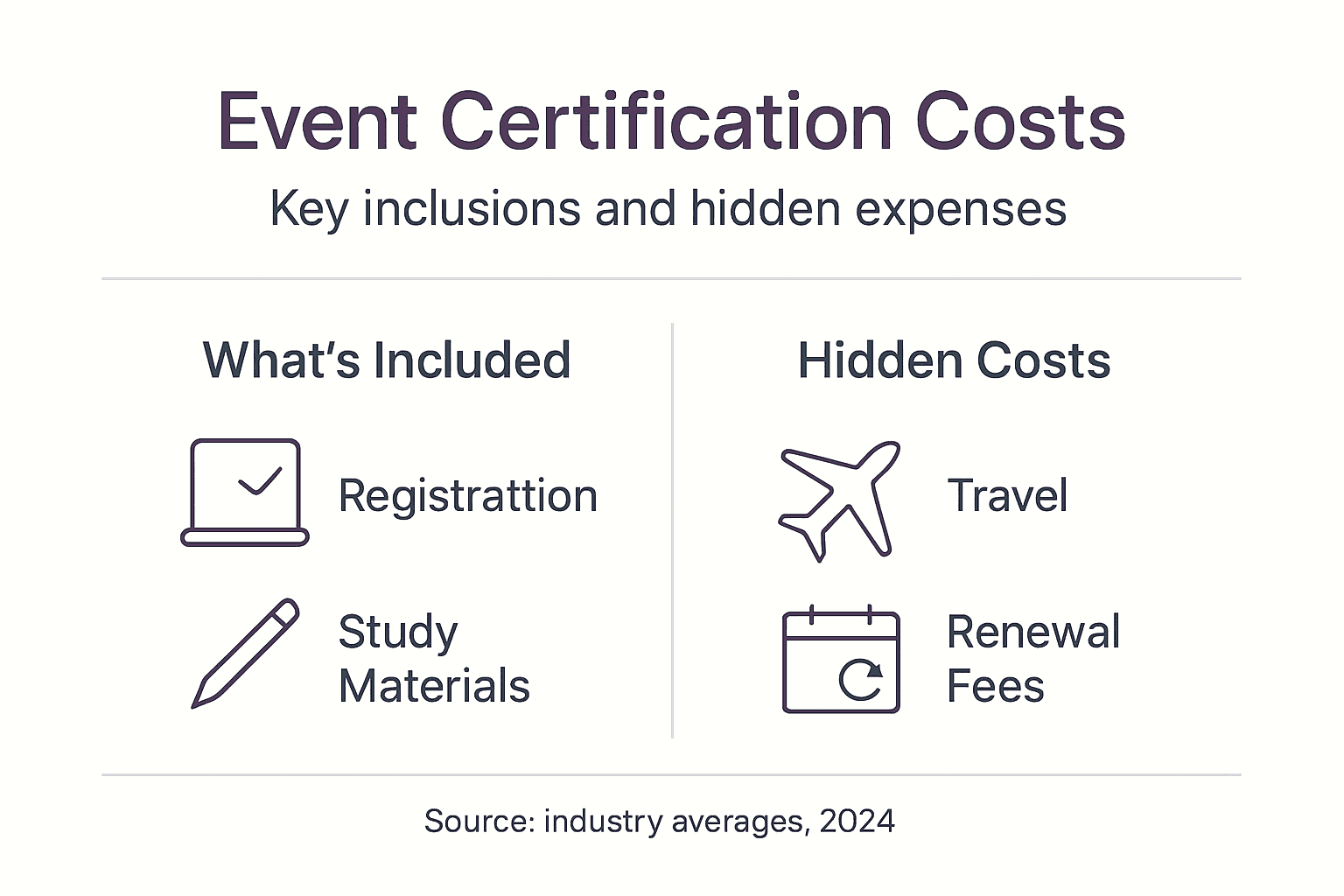
What’s Typically Included In Certification Fees
When you pay the advertised certification cost, you generally receive:
- Application and registration fees – administrative costs to enrol in the programme
- Study materials and resources – course content, videos, textbooks, downloadable guides
- Access to learning platforms – online portals where you access lessons and track progress
- Examination fees – the formal certification exam itself
- Practice exams and assessments – preparation materials to help you succeed
- Basic instructor support – access to teaching staff during course duration
What’s Explicitly Excluded
Many costs fall outside the standard fee structure. You’ll pay separately for:
- Continuing education credits – mandatory renewal requirements after certification expires
- Annual membership fees – joining professional associations or maintaining credentials
- Travel and accommodation – if in-person exams, workshops, or networking events are required
- Additional software and tools – specialised event planning software not bundled in the course
- Supplementary books and resources – recommended reading materials beyond core materials
- Professional certification renewal – costs to renew your credential after 2–3 years
- Premium career services – advanced job placement assistance or one-to-one mentoring
Hidden Costs To Anticipate
Beyond exclusions, anticipate unexpected expenses:
If your certification requires attending workshops in Mumbai or Delhi, budget for travel, meals, and accommodation. Some programmes demand purchasing specific event management software costing ₹5,000–₹20,000 annually.
Professional association memberships, often recommended for career advancement, add ₹3,000–₹10,000 yearly in India.
The Real Total Cost Of Certification
Calculate your actual investment by adding:
- Programme fee
- Travel expenses (if applicable)
- First-year renewal or membership costs
- Recommended additional resources
- Software subscriptions
A ₹80,000 certification might actually cost ₹125,000–₹150,000 when you include travel, renewal fees, and software in year one.
Questions To Ask Before Enrolling
Before committing funds, clarify:
- What materials are included, and what must you purchase separately?
- Are renewal fees lifetime or annual?
- Do professional association memberships cost extra?
- Are in-person components mandatory, and who covers travel costs?
- What software or tools require additional purchase?
Pro tip: Request a detailed cost breakdown spreadsheet from providers before enrolling—list every single fee including renewal, software, travel, and association memberships for at least three years, so you understand the true long-term investment rather than just the advertised programme cost.
Factors Affecting Your Total Investment
Your certification cost depends on multiple interconnected variables. Understanding each factor helps you predict your actual spending and make smarter choices.
Think of certification investment like building a house—the base price matters, but location, materials, and optional additions dramatically change the final bill.
Your Geographic Location
Where you live significantly impacts costs. India-based programmes cost substantially less than American or European equivalents due to lower operational expenses and regional economic differences.
A certification costing ₹80,000 in Bangalore might cost $1,500+ (approximately ₹125,000) in the United States. This geographical advantage makes Indian certifications excellent value for aspiring event professionals.
Certification Prestige And Reputation
Highly recognised credentials command premium prices. The CMP, with global standing across 55 countries, costs more than emerging certifications from newer institutes.
Established certifying bodies invest heavily in quality assurance, industry partnerships, and alumni networks. You’re paying partly for the credential’s market value and employer recognition.
Programme Scope: Specialised Versus General
Broad certifications covering corporate, wedding, and social events cost differently than specialised programmes focused solely on sports event management or conferences.
Specialised programmes often cost less because they cover narrower content, yet may deliver superior value if they align precisely with your career goals.
Delivery Format Choices
Online, in-person, and hybrid training models affect your investment:
- Online self-paced: lowest cost, maximum flexibility, self-discipline required
- Live online instructor-led: moderate cost, structured learning, real-time interaction
- In-person classroom: highest cost, includes facility expenses, hands-on practical work
- Hybrid blended: moderate to high cost, combines flexibility with in-person practice
Your Existing Experience Level
Certifications for beginners typically cost less than advanced programmes requiring prior industry experience. Entry-level programmes in India start around ₹20,000, whilst advanced credentials range ₹100,000–₹300,000.
Your background also affects whether you need preparatory courses, which add additional costs.
Long-term Renewal And Ongoing Costs
Initial certification cost represents only year one. Factor in:
- Annual renewal fees (₹5,000–₹15,000 typically)
- Mandatory continuing education (₹8,000–₹20,000 annually)
- Professional membership upgrades
- Required software subscriptions
Over five years, a ₹80,000 certification might total ₹200,000–₹250,000 when you include renewals and professional development.
Return On Investment Expectations
Higher certifications typically lead to better salaries and career advancement. Entry-level positions might offer ₹4–₹6 lakhs annually, whilst certified senior professionals earn ₹10–₹20 lakhs or more.
Calculate whether the certification’s cost aligns with realistic salary increases in your target role.
Pro tip: Create a five-year cost projection spreadsheet including programme fees, annual renewals, continuing education, software, and travel, then compare it against projected salary increases in your target role to determine whether the investment delivers genuine return on investment.
Understand Your Investment and Advance Your Career in Event Management
Navigating the true cost of event planning certification can be challenging with so many factors affecting your total investment. From programme scope and delivery format to hidden fees like renewal costs and software subscriptions, understanding these details is crucial to making an informed choice. If you want to avoid surprises and ensure that your certification aligns with your career goals—whether in corporate events, weddings or sports management—it is vital to choose a recognised programme that delivers practical skills and industry connections.
At teami.org, backed by 23 years of excellence and strong partnerships like with DNA Entertainment Networks, we provide specialised, affordable certification courses designed for India’s dynamic event industry. Our online and hybrid programmes offer hands-on projects, internships, and tailored specialisations so you can get real-world experience while managing your budget. Explore our Career in Event Management section to see how we align comprehensive training with your career ambitions and pave the way to solid job placements.
Don’t let uncertainty over certification costs hold you back from advancing in this rapidly growing field. Get expert guidance on course options and fees now. Connect directly through our contact page for personalised advice and start your journey to becoming a certified event professional today.
Frequently Asked Questions
What factors influence event planning certification costs?
The cost of event planning certification can be influenced by geographic location, the prestige and reputation of the certification body, the scope of the programme, the delivery format chosen (online, in-person, or hybrid), your existing experience level, and long-term renewal costs.
What is included in the certification fees for event planning?
Certification fees typically cover application and registration fees, study materials, access to learning platforms, examination fees, practice exams, and basic instructor support during the course duration.
Are there any hidden costs to consider when enrolling in an event planning certification programme?
Yes, aside from the base certification fees, you should consider additional costs such as continuing education credits, annual membership fees, travel and accommodation for in-person components, software subscriptions, and costs related to professional certification renewal.
How can I determine the best certification programme for my career goals?
To choose the best certification programme, compare the curriculum against your ideal job description, consider the breadth of event types covered in the certification, assess industry recognition, and evaluate the cost versus the practical components offered in terms of internships or live event exposure.