

Most british event planners underestimate the value of clearly defined objectives at the start. Without a strong foundation, even the best venues and creative concepts fall short of expectations. Setting precise goals and requirements from the beginning guides every decision and helps avoid the common trap of last-minute chaos. This step-by-step guide offers practical strategies and proven methods so your next british event is not just well-organized but stands out in every detail.
Table of Contents
- Étape 1: Define Event Objectives And Requirements
- Étape 2: Map Key Milestones And Tasks Chronologically
- Étape 3: Allocate Responsibilities And Confirm Resources
- Étape 4: Synchronise Team Actions With Contingency Plans
- Étape 5: Validate Timeline Accuracy And Readiness
Quick Summary
| Key Point | Explanation |
|---|---|
| 1. Define Clear Objectives | Set Specific, Measurable, Achievable, Relevant, and Time-bound (SMART) goals to guide event planning effectively. |
| 2. Chronologically Map Milestones | Organise event tasks into a visual timeline, identifying essential milestones and maintaining flexibility for adaptations. |
| 3. Allocate Responsibilities Wisely | Ensure tasks match team members’ skills and establish clear financial and accountability protocols for budget management. |
| 4. Develop Contingency Plans | Create backup strategies for possible disruptions, ensuring rapid response without losing event momentum. |
| 5. Validate Timeline and Readiness | Conduct comprehensive reviews and simulations to identify gaps and ensure all aspects of the event plan are executable. |
Étape 1: Define event objectives and requirements
The first critical step in event timeline planning is establishing crystal clear objectives that will serve as your strategic roadmap. Crafting precise event objectives requires thoughtful consideration and a systematic approach that transforms abstract goals into actionable plans.
Utilising the SMART framework recommended by leading academic institutions like the National University of Singapore, your event objectives must be Specific, Measurable, Achievable, Relevant, and Time-bound. This means moving beyond vague aspirations to create concrete, quantifiable targets. For instance, rather than stating “increase attendee engagement,” a SMART objective might read “Generate 250 active participant interactions during the three-hour conference, measured through real-time digital polling and networking session metrics.”
Careful requirement gathering follows objective definition. Start by conducting stakeholder interviews to understand expectations, constraints, and desired outcomes. Document every requirement meticulously identifying potential challenges, resource needs, and success metrics. One practical tip always build a 10-15% buffer into your initial plans to accommodate unexpected variables. This approach ensures your event timeline remains flexible while maintaining strategic integrity.
Your next step involves translating these carefully defined objectives into a comprehensive event blueprint that will guide subsequent planning stages.
Étape 2: Map key milestones and tasks chronologically
Transforming your event objectives into a structured timeline requires meticulous organisation and strategic task mapping techniques. This critical stage involves breaking down your event blueprint into manageable segments that create a comprehensive and realistic planning trajectory.

Researchers have developed sophisticated approaches to visualising project timelines. Utilising advanced polynomial-time algorithms can help you minimise complex scheduling challenges and optimise your milestone representation. Start by identifying primary event milestones such as venue booking, vendor confirmations, marketing launches, and registration deadlines. Each milestone should connect logically with corresponding preparatory tasks, creating a sequential flow that accounts for potential interdependencies and buffer periods.
When plotting your chronological map, consider creating a visual timeline that allows real-time tracking and collaboration. Digital tools can help you allocate precise timeframes for each task while maintaining flexibility. One practical strategy involves colour coding milestones by category or criticality ensuring that high priority items receive immediate attention. Remember to build contingency windows between major milestones to accommodate unexpected developments without derailing your entire event strategy.
With your milestones and tasks meticulously mapped, you are now prepared to dive into detailed resource allocation and specific task assignments.
Étape 3: Allocate responsibilities and confirm resources
With your event milestones mapped, the next critical phase involves strategically distributing tasks and securing the necessary resources to transform your blueprint into reality. Effective resource allocation requires a precise approach that matches team members skills with specific event responsibilities.
Following recommendations from educational event management guidelines, establish clear financial objectives and management protocols. This means creating a comprehensive budget that outlines not just expenditure, but also precise accountability for each spending category. Develop a responsibility matrix that clearly delineates who approves expenses, who tracks budgetary compliance, and who manages specific financial segments. Utilising the SMART criteria Specific, Measurable, Agreed upon, Relevant, and Time bound ensures that each team members role comes with quantifiable expectations and measurable performance indicators.
When confirming resources, conduct a thorough capability assessment of your team. Match individual strengths with complex tasks for instance, your most detail oriented team member might manage vendor contracts, while your most creative colleague could handle marketing and promotional strategies. Build in redundancy by identifying backup personnel for critical roles, ensuring your event timeline remains robust even if primary team members become unavailable. One practical tip is to create a shared digital dashboard where everyone can track their responsibilities, deadlines, and interdependencies in real time.
With responsibilities allocated and resources confirmed, you are now prepared to develop a comprehensive communication strategy that will keep your entire team aligned and focused.
Étape 4: Synchronise team actions with contingency plans
Successful event management hinges on creating a dynamic framework that anticipates potential disruptions while maintaining seamless team coordination. Event chain methodology offers sophisticated visual tools for mapping potential risks and interconnected task dependencies that could impact your overall event strategy.
Develop a comprehensive contingency plan by generating strategic event sequences that account for multiple potential scenarios. This involves creating a cascading decision matrix where each potential disruption has a predefined response protocol. Start by identifying critical path tasks that could potentially derail your entire event if delayed or compromised. For each high risk area, design multiple backup strategies that allow rapid pivoting without losing momentum. Your contingency plan should include alternative vendor contacts, backup venue options, emergency communication channels, and flexible resource allocation mechanisms.
Communicate these contingency protocols transparently with your entire team, ensuring everyone understands their adaptive responsibilities. Conduct a comprehensive simulation or tabletop exercise where team members walk through potential disruption scenarios, practicing their response mechanisms. One practical strategy is to colour code different contingency levels green for minimal impact, amber for moderate disruption, and red for critical intervention helping team members quickly understand the severity and required actions. Regular communication checkpoints and a shared digital dashboard will help maintain real time alignment and quick decision making capabilities.
With your synchronisation strategy and contingency plans in place, you are now prepared to move into the detailed execution phase of your event management journey.
Étape 5: Validate timeline accuracy and readiness
The final checkpoint in event timeline planning involves a rigorous validation process that ensures every detail aligns with your strategic objectives. Temporal diversity and content verification are crucial techniques for confirming your event blueprint represents a comprehensive and executable plan.
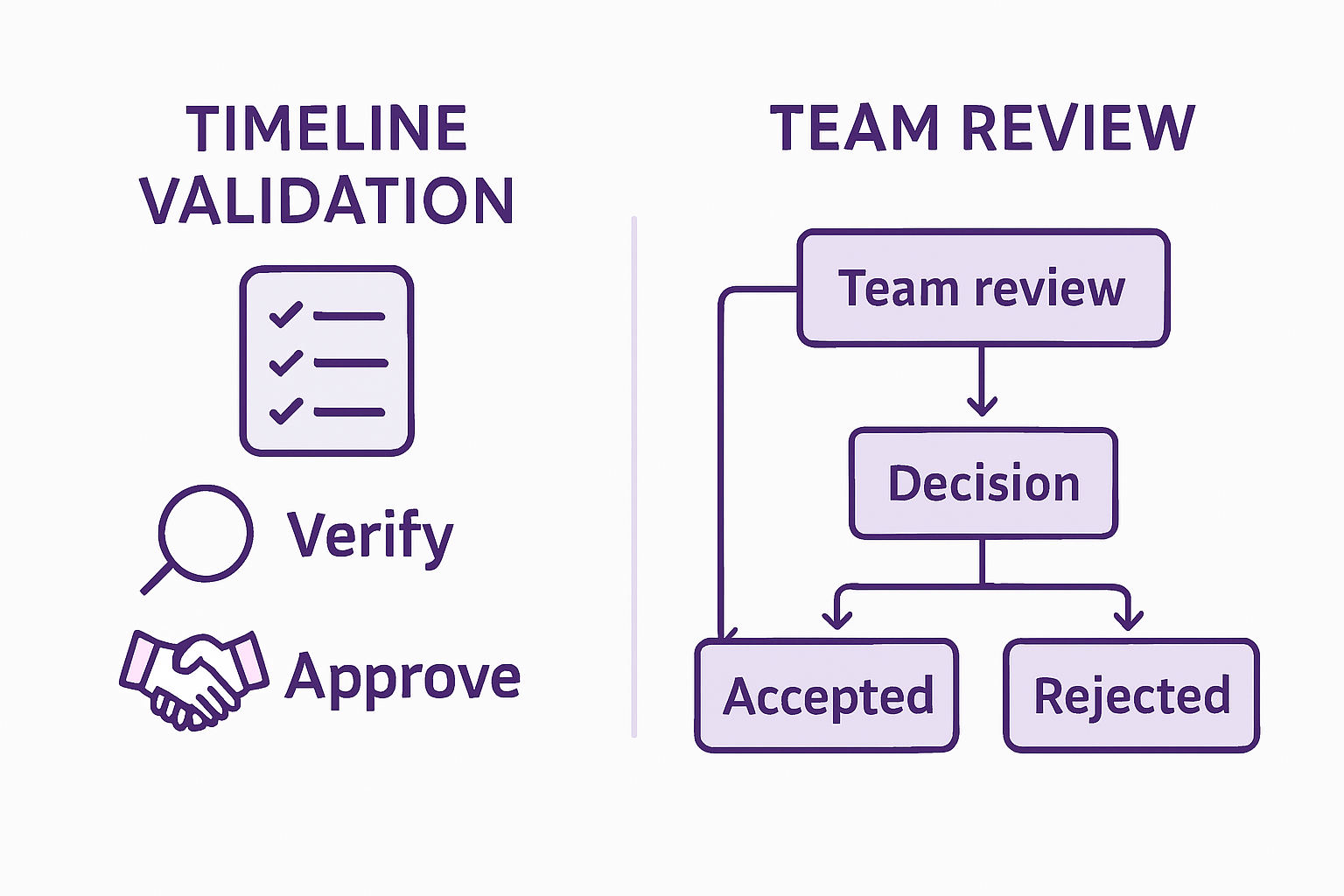
Practical validation requires a systematic requirements elicitation approach that thoroughly examines each component of your event timeline. Conduct a comprehensive stakeholder review where every team member critically assesses their assigned tasks, timelines, and potential interdependencies. This multi perspective validation helps identify potential gaps, unrealistic expectations, or hidden bottlenecks that might have been overlooked during initial planning. Create a structured checklist that covers technical feasibility, resource allocation, risk management, and contingency preparedness. Pay special attention to critical path tasks that could potentially derail the entire event if not executed precisely.
Implement a robust peer review mechanism where team members cross validate each others segments of the timeline. This collaborative approach not only enhances overall accuracy but also builds collective ownership and understanding of the event strategy. One practical tip is to conduct a full simulation or dress rehearsal that walks through the entire timeline, allowing you to stress test your plan under near real world conditions. Use digital collaboration tools that allow real time annotations, feedback, and tracking of validation comments. Your goal is to transform your initial event blueprint from a theoretical document into a battle tested, dynamically responsive roadmap.
With your timeline validated and refined, you are now prepared to transition from planning to precise, confident execution.
Elevate Your Event Planning Skills for Flawless Execution
Mastering the detailed steps of event timeline planning such as defining SMART objectives, mapping milestones, and synchronising team actions with contingency plans can be challenging without expert guidance. This article highlights the importance of thorough task mapping, resource allocation, and rigorous timeline validation to avoid common pitfalls that disrupt seamless event delivery.
At team.i.org, we understand these critical pain points and provide specialised training designed to equip aspiring event managers with practical skills and industry insights. Benefit from our 23 years of experience and hands-on learning opportunities including internships and real event participation. Join our trusted certification programmes that cover every aspect of event management to confidently transform your planning into successful outcomes.
Take control of your event career today by exploring our comprehensive courses and expert resources at team.i.org. Ready to advance your skills and access personalised mentorship connect directly here and step into a future of successful event management with confidence.
Frequently Asked Questions
How do I define clear objectives for my event timeline planning?
To define clear objectives, utilise the SMART framework—ensure your goals are Specific, Measurable, Achievable, Relevant, and Time-bound. Start by detailing what you want to accomplish, such as generating a specific number of participant interactions, to create a focused action plan.
What is the best way to map key milestones and tasks chronologically?
Begin by identifying primary milestones such as venue booking and vendor confirmations, then break down each milestone into actionable tasks. Create a visual timeline to track these milestones in real-time, allowing you to maintain flexibility and adjust as needed.
How can I allocate responsibilities effectively among my team?
Allocate responsibilities by matching individual team members’ skills to specific tasks using a responsibility matrix. Set clear expectations for each role, ensuring that all members know their obligations and related deadlines to facilitate seamless collaboration.
What should I include in my event contingency plan?
Your contingency plan should identify critical path tasks and outline predefined response protocols for potential disruptions. Include backup strategies like alternative vendor contacts and emergency communication channels to ensure your team can adapt quickly without losing momentum.
How do I validate the accuracy of my event timeline before execution?
To validate your event timeline, conduct a comprehensive stakeholder review, allowing each team member to assess their tasks for feasibility and interdependencies. Use a checklist to identify any gaps and perform a full simulation of the event to stress-test the plan before the actual execution.