
Stepping into the world of event management, you quickly realise that lectures alone won’t prepare you for the real pressure of live events. Today’s employers in places like London, Bangalore and Sydney value meaningful direct experiences with guided reflection over textbook theory. If you want to stand out in the fast-paced event industry, learning by actually planning and running events makes all the difference. This article explores how experiential learning bridges the gap between classroom knowledge and true professional capability.
Table of Contents
- Defining Experiential Learning in Event Management
- Key Approaches and Learning Models Explained
- How Experiential Learning Develops Industry Skills
- Integrating Reflection and Evidence-Based Practice
- Pitfalls to Avoid in Experiential Learning Experiences
Key Takeaways
| Point | Details |
|---|---|
| Experiential Learning Advantage | Engaging in hands-on event management provides practical skills that theory alone cannot deliver, enhancing employability. |
| Importance of Reflection | Regular reflection after events is crucial for deep learning and understanding of industry best practices. |
| Integration of Evidence-Based Practices | Aligning reflections with established industry standards fosters continuous improvement and adaptability in event management. |
| Avoiding Common Pitfalls | Successful experiential learning requires structured support and clear assessment criteria to maximise skill development. |
Defining Experiential Learning in Event Management
Experiential learning in event management is fundamentally different from sitting in a lecture hall taking notes. It’s the practice of learning by doing, where you gain knowledge through direct involvement in planning, executing, and reflecting on live events. Rather than simply studying event theories, you step into the role of an event manager from day one, handling real problems, real vendors, and real attendees. Experiential learning combines meaningful direct experiences with guided reflection, transforming abstract concepts into practical competencies that employers actually value.
The roots of this approach run deep. Educational theorists like John Dewey recognised that people learn most effectively when they actively participate in the learning process rather than passively receive information. Building on this foundation, modern experiential learning follows a clear cycle: you experience something concrete (like coordinating catering logistics for a 200-person conference), reflect on what happened (what worked, what didn’t), conceptualise the underlying principles (why certain decisions led to success or failure), and then apply those lessons to the next event. This isn’t theoretical knowledge sitting in textbooks. This is the kind of learning that sticks because you’ve lived through it, made mistakes, and figured out solutions under pressure.
In the Indian event industry context, experiential learning has become essential. Training programmes increasingly emphasise practical vocational skills linked to real events. Whether you’re working with event management institutes in Bangalore or learning through understanding what event management courses actually teach, the focus has shifted decisively toward hands-on experience. You might spend mornings in workshops learning about vendor negotiation, then afternoons implementing those skills with actual suppliers. By the time you graduate, you’ve already managed multiple live events, handled real budgets, and solved genuine logistical challenges that occur in Indian venues, corporate spaces, and entertainment landscapes.
What makes this approach powerful is that it directly addresses the employability gap. Event management isn’t something you can master through theory alone. You need to understand crowd flow dynamics, vendor relationships, timeline management, and crisis handling. Experiential learning weaves all of these together, ensuring you develop not just knowledge but genuine professional capability that clients and employers recognise immediately.
Pro tip: When selecting an event management course, ask how many live events students actually plan and execute during the programme. The more events you touch, the more skilled you’ll be when you enter the job market.
Key Approaches and Learning Models Explained
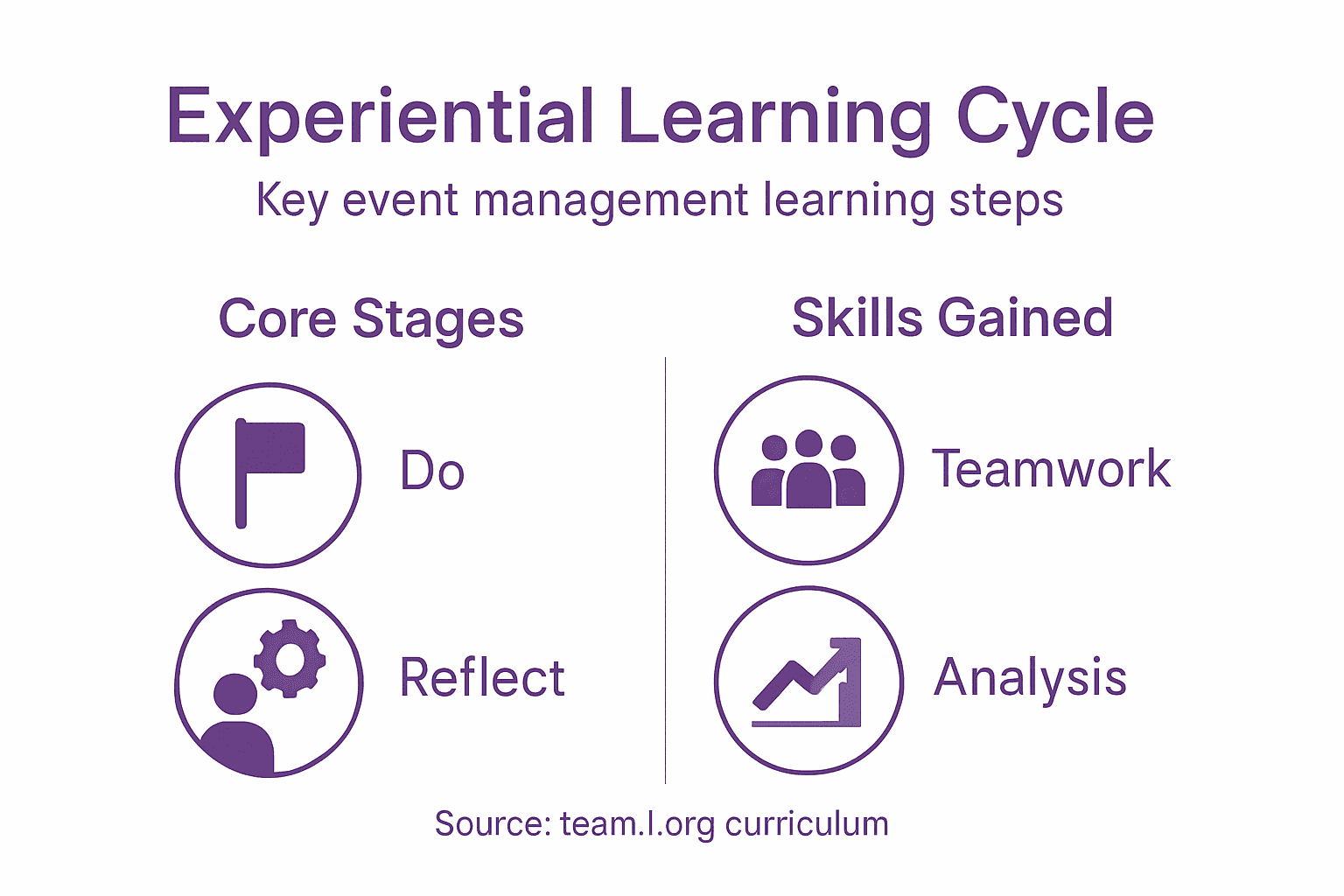
When you step into an event management course focused on experiential learning, you’ll encounter several structured approaches designed to transform raw experience into genuine expertise. The most influential framework is Kolb’s Experiential Learning Theory, which has shaped how educators design courses across the industry. This model operates as a four-stage cycle of concrete experience, reflection, conceptualisation, and experimentation that you’ll move through repeatedly as you work on different events. Think of it as a spiral rather than a single loop. You plan a corporate conference (concrete experience), sit down afterwards to analyse what worked and what didn’t (reflection), extract principles about vendor management or crowd flow (conceptualisation), and apply those lessons to your next assignment (active experimentation). Then the cycle repeats with new challenges and deeper understanding.
Here is a concise summary of how Kolb’s Experiential Learning Cycle applies to event management:
| Stage of Cycle | Typical Event Management Task | Skills Developed |
|---|---|---|
| Concrete Experience | Planning and running an event | Organisation, teamwork |
| Reflective Observation | Analysing event outcomes | Critical thinking, self-assessment |
| Abstract Conceptualisation | Drawing lessons from experience | Strategic planning, synthesising knowledge |
| Active Experimentation | Applying improvements to next event | Adaptability, innovation |
Beyond Kolb’s foundational model, event management programmes increasingly incorporate critical reflection practices and approaches grounded in how your brain actually learns. These variations recognise that different people absorb information differently. Some of you learn best by jumping straight into execution and figuring things out. Others need to step back and think deeply about why something failed before trying again. A strong experiential learning programme acknowledges these differences and structures activities accordingly. You might spend time journaling about your event experiences, engaging in peer feedback sessions where classmates challenge your assumptions, or working through case studies of real events that went wrong in Indian venues like Mumbai’s MMRDA grounds or Bangalore’s convention centres. The goal remains constant: convert messy, real-world experience into transferable professional capability.
In practice, this means your course structure shifts dramatically. Rather than lectures about event logistics, you’re actually coordinating those logistics. Rather than reading case studies about vendor negotiation, you’re negotiating with actual suppliers for your class event. Event management education now integrates practical participation in live events with resource support and structured assessment, ensuring you develop genuine employability. This isn’t a nice addition to your education. This is the core of it. Your assignments include planning and executing real conferences, product launches, weddings, or corporate gatherings. The feedback you receive comes not just from tutors but from actual clients and attendees. That’s accountability that textbook learning simply cannot provide.
The following table compares traditional event management education with experiential learning approaches:
| Learning Approach | Mode of Delivery | Graduate Readiness | Typical Assessment |
|---|---|---|---|
| Traditional Theory-Based | Mainly lectures and textbooks | Limited hands-on skills | Written exams, essays |
| Experiential Learning | Live event practice and reflection | Highly industry-ready | Client feedback, event outcomes |
Pro tip: When comparing event management programmes, ask whether they use real events with paying clients or just practice events. Programmes where you handle genuine client relationships teach you professional responsibility that completely transforms your readiness for the job market.
How Experiential Learning Develops Industry Skills
The beauty of experiential learning is that it doesn’t just teach you facts about event management. It systematically builds the exact skills that employers actually demand. When you work through realistic event scenarios with real consequences, you develop communication, time management, and problem-solving abilities that lectures simply cannot provide. Rather than learning about vendor negotiations from a textbook, you’re sitting across from actual suppliers, negotiating contracts, handling objections, and managing relationships. That experience reshapes how you think. Authentic assessment in event management education significantly enhances development of key professional competencies such as communication, time management, and content management, embedding industry practices directly into your training. You’re not just learning about event processes. You’re developing the exact expertise that separates competent event managers from exceptional ones.
Consider what happens when you actually execute an event. Budget constraints force you to make real financial decisions. Vendor delays force you to develop contingency planning and crisis management. Difficult clients force you to refine your communication and negotiation strategies. Tight timelines force you to prioritise ruthlessly and manage resources efficiently. These aren’t simulated challenges. They’re genuine problems with real stakes. A 50-person conference you’re organising for a Bangalore tech startup doesn’t have a “reset button” if you mess up the catering logistics. That accountability transforms how seriously you approach your work, and it accelerates your professional development dramatically. Your soft skills improve because you’re forced to interact with real professionals, interpret their needs accurately, and deliver results that satisfy them.

What makes this approach particularly powerful is the cumulative effect. Research confirms that systematic experiential learning involving repeated authentic events positively impacts professional identity and skill development of event management students, preparing graduates who are adaptable and industry-ready. You don’t just execute one event and suddenly become skilled. You execute multiple events across different formats and scales. Your first event teaches you fundamentals. Your second event teaches you to recognise patterns. By your fifth event, you’re making sophisticated strategic decisions. Faculty and industry professionals notice improvements in both technical skills (budgeting, timeline management, logistics coordination) and soft skills (negotiation, conflict resolution, stakeholder communication). When you enter your first job, you’re not starting from zero like graduates from traditional programmes. You’ve already done this work multiple times. You understand the rhythm, the pressure points, and how to navigate them.
Pro tip: During your course, volunteer to manage the most challenging aspects of events, not the easiest ones. Managing a difficult vendor relationship or handling a crisis teaches you far more than executing a flawlessly planned segment, and that experience is what employers value most when hiring.
Integrating Reflection and Evidence-Based Practice
Here’s something that separates good event managers from great ones: they don’t just do events, they analyse them afterwards. Reflection is the secret ingredient that transforms raw experience into genuine learning. You can execute a 200-person corporate gala flawlessly from a logistical standpoint, but if you don’t sit down afterwards and ask yourself what actually worked, what fell flat, and why, you haven’t truly learned. Reflection is essential for linking experience to abstract theoretical insights and effective knowledge construction, turning your messy real-world experience into structured professional wisdom. This is where many traditional event management programmes fail. They give you experience but skip the critical step of making you think deeply about that experience. A strong programme insists you reflect systematically. You might write journal entries about decisions you made during an event. You might participate in debrief sessions with your team where you dissect what happened. You might complete structured reflection forms that force you to connect your experience to industry best practices and theoretical concepts you’ve studied.
The second crucial element is evidence-based practice. This means you’re not just reflecting randomly. You’re reflecting against actual industry standards, successful case studies, and research about what works in event management. When you managed vendor relationships during your last event, did you follow recommended negotiation frameworks? When you handled a crisis, did your response align with established crisis management protocols? Integrating reflective practice with evidence-based approaches supports critical evaluation of engagement and outcomes, fostering continuous improvement in event management, particularly when adapting to new circumstances or technologies. A good programme connects your reflections to the broader body of knowledge about event management. You’re not just learning from your own experience. You’re learning from thousands of other event managers’ experiences, distilled into best practices and frameworks. When you transition between managing in-person conferences in Delhi and virtual webinars for distributed audiences, evidence-based practice helps you apply lessons from one context to another. You understand that attendee engagement principles differ between formats, so you adapt your strategies systematically rather than guessing.
In practical terms, this integration works like this: you execute an event, then you reflect on specific aspects using guided questions. What surprised you? What would you do differently? How did your actual decisions compare to industry recommendations you studied? You compare your reflections against case studies of similar events, identifying patterns. You discuss your findings with peers and faculty who challenge your assumptions and point you towards additional research. This creates a feedback loop where each event makes you progressively more skilled, not just more experienced. You’re building judgement, not just accumulating stories.
Pro tip: Keep a detailed reflection journal throughout your course, not just brief notes. Write about specific decisions you made, why you made them, what happened, and what you’d change. Review it before each new event to identify patterns in your decision-making and consciously improve your approach.
Pitfalls to Avoid in Experiential Learning Experiences
Experiential learning sounds straightforward until you see it implemented poorly. The most dangerous trap is treating experience as the end goal rather than the beginning of learning. Some programmes throw students into events and assume they’ll automatically develop expertise. You execute a wedding, you’re done, move to the next one. But without structured reflection and critical analysis, you’re just accumulating stories rather than building professional capability. Common pitfalls include lack of structured reflection, insufficient support and resources, and poorly designed assessments that fail to connect experience with learning objectives. Overemphasis on the experience itself without guided analysis severely limits what you actually learn. A corporate conference might run smoothly on the surface, but if nobody sits down afterwards to help you understand why certain decisions worked or how your approach compared to industry best practices, you’re missing the entire educational value. The experience becomes background noise rather than a learning opportunity.
Another critical pitfall is inadequate resourcing. Some programmes claim they offer experiential learning but provide minimal support. You’re expected to somehow organise a 500-person corporate event with practically no budget, no mentorship from experienced professionals, and no access to industry contacts or venues. That’s not experiential learning. That’s just setting you up for failure. Without thorough planning of teaching content, adequate resources and support, and clear assessment criteria, experiential learning fails to achieve its full potential in skill development. When you’re scrambling to find venues in Bangalore, struggling to negotiate with vendors, or managing impossible timelines because the programme didn’t properly plan the event, you’re learning stress management more than event management. Strong programmes invest in proper course design. They partner with real venues and vendors. They assign experienced mentors. They ensure you have the resources to actually succeed, so your learning comes from navigating professional-level challenges, not from surviving chaos.
Weakness in assessment and clarity is another common problem. You complete an event, but how is your performance actually evaluated? Are the assessment criteria clear? Does your assessment focus on genuine industry-relevant skills or arbitrary metrics? Some programmes assess whether your event “looked nice” rather than whether you managed budgets effectively, handled vendor relationships professionally, or solved genuine logistical problems. Without clear links to employability outcomes, you can’t be sure whether you’re developing skills that employers actually value. A proper programme has transparent assessment criteria aligned with industry standards. You know exactly what you’re being evaluated on, and you understand how your performance reflects real professional competency. This clarity ensures you’re learning strategically rather than wondering what actually matters.
Pro tip: When evaluating event management programmes, ask to see assessment rubrics and interview recent graduates about whether they felt their course properly resourced the events and included meaningful reflection. If they describe chaos without learning support, that programme is cutting corners on experiential learning.
Unlock Your Potential with Experiential Learning at team.i.org
Experiential learning is vital for emerging event managers to bridge the gap between theory and real-world challenges. If you are seeking to develop critical skills like vendor negotiation, crisis management, and reflective practice, you need a training partner that offers more than textbooks. At team.i.org, our programmes combine 23 years of industry expertise with hands-on projects, live event participation, and professional mentorship. This immersive approach ensures you gain the practical experience and evidence-based insights necessary to excel in social, sports, wedding, or corporate event management.
Don’t let theoretical knowledge hold you back. Embrace the power of structured reflection and authentic assessment within a supportive environment designed to build your professional identity. Explore our diverse certificate programmes, leverage partnerships with leading entertainment networks, and join a community committed to transforming learners into industry-ready leaders. Ready to shape your future as a skilled event manager Why wait Discover how our experiential learning focus can elevate your career today by connecting with us at team.i.org. Take the first step towards mastering event management through real-world experience and proven success.
Frequently Asked Questions
What is experiential learning in event management?
Experiential learning in event management is a hands-on approach where individuals learn by actively participating in planning and executing live events, rather than just studying theories in a classroom.
How does Kolb’s Experiential Learning Cycle apply to event management education?
Kolb’s Experiential Learning Cycle consists of four stages: concrete experience, reflective observation, abstract conceptualisation, and active experimentation. This cycle allows students to learn from actual event experiences and apply those lessons to future assignments.
Why is reflection important in experiential learning for event managers?
Reflection is crucial as it helps to analyse experiences, understand what worked and what didn’t, and connect those insights to industry best practices, thus transforming practical experiences into valuable learning.
What skills can be developed through experiential learning in event management?
Experiential learning helps develop essential skills such as communication, time management, problem-solving, strategic planning, vendor negotiation, and crisis management, which are highly valued by employers in the event industry.
Recommended
- What Is Experiential Marketing and Why It Matters – team I
- Leadership Development for Youth: Skills for Future Success – team I
- Top Event Management Workshops 2025: Courses for Career Growth – team I
- Future Workplace Skills: What Event Managers Need Now – team I
- 7 Mistakes to Avoid With Your Designer CEUs – CEU Builder
- 10 Winning CEU Course Topics for Hospitality Manufacturers – CEU Builder