

You’ve spent months researching event management courses, only to discover that not all degrees carry the same weight with employers. Recognition isn’t just a certificate on the wall, it’s your ticket to credibility in India’s competitive event planning industry. Understanding which qualifications matter and how to verify them can save you years of frustration and open doors to rewarding career opportunities. This guide breaks down everything you need to know about degree recognition, from government approval to industry acceptance, helping you make informed decisions about your education path.
Table of Contents
- What Does Event Management Degree Recognition Mean In India?
- How To Verify If Your Event Management Degree Is Recognised
- Comparing Recognised Degrees, Diplomas And Certifications In Event Management
- Why Recognised Event Management Degrees Boost Your Career Prospects In India
- Explore Recognised Event Management Courses And Certification With Team I
- FAQ
Key takeaways
| Point | Details |
|---|---|
| Recognition determines credibility | Employers prioritise candidates with verified qualifications from accredited institutions |
| Accreditation matters | AICTE and UGC approval signals that your degree meets national education standards |
| Certification complements degrees | Industry-recognised certificates prove specialised skills and boost employability |
| Verification prevents wasted investment | Checking official databases ensures you choose legitimate courses that advance your career |
What does event management degree recognition mean in India?
Recognition is the official stamp of approval that tells employers your education meets specific standards. In India’s event management sector, this involves multiple layers: government educational authorities verify academic quality, whilst industry bodies assess practical relevance. Recognition involves approval by Indian educational authorities and industry bodies, ensuring degree credibility. Without this dual validation, your degree might look impressive on paper but fall flat when you’re competing for jobs.
The University Grants Commission (UGC) and All India Council for Technical Education (AICTE) serve as primary gatekeepers for higher education recognition. These bodies evaluate curriculum content, faculty qualifications, infrastructure, and learning outcomes before granting approval. When an institution receives AICTE recognition, it signals that their event management programme meets national technical education standards. UGC recognition applies primarily to university degrees, ensuring they align with broader academic frameworks.
Industry acceptance operates differently from government approval. Event planning firms, wedding organisers, corporate event departments, and entertainment companies look for graduates who can deliver results from day one. They value practical skills, industry connections, and hands-on experience alongside academic credentials. This is why choosing the best event management degree in India requires balancing official recognition with industry reputation.
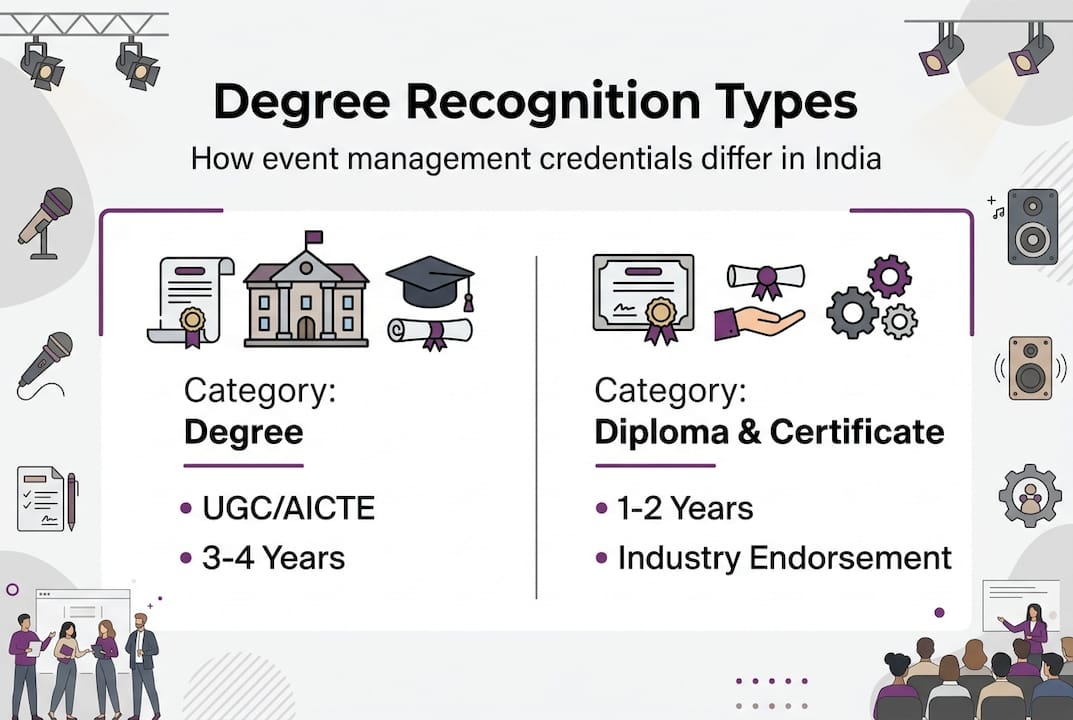
The qualification landscape includes degrees, diplomas, and certificates, each with different recognition criteria:
- Degrees typically require three to four years and carry full university recognition
- Diplomas range from one to two years and may have AICTE or state board approval
- Certificates focus on specific skills and often carry industry body endorsements
- Advanced diplomas bridge the gap between basic diplomas and full degrees
Many students stumble when considering foreign degrees without Indian equivalence. A qualification from an international institution might be excellent, but Indian employers often struggle to assess its value without local accreditation. You’ll need to get foreign degrees evaluated by the Association of Indian Universities or similar bodies to establish their Indian equivalent status.
How to verify if your event management degree is recognised
Verification starts with official government databases. Visit the AICTE website and search their approved institutions list using the college or university name. The portal shows approval status, programme details, and intake capacity. For university degrees, check the UGC website’s list of recognised universities. State education departments maintain separate databases for state-approved institutions, which you should consult for regional colleges.
Students should check official educational authority lists and industry endorsements when selecting courses. Industry accreditation adds another layer of validation. Professional bodies like the Event and Entertainment Management Association (EEMA) or similar organisations sometimes endorse specific programmes. Look for partnerships with major event companies, which signal that curriculum aligns with industry needs. DNA Entertainment Networks, for example, collaborates with select institutes to ensure training meets real-world requirements.
Alumni success stories provide practical evidence of recognition value. Research where graduates work, their job titles, and career progression speed. LinkedIn profiles reveal placement patterns, whilst college websites often showcase notable alumni. If graduates consistently land positions at respected event firms, that’s strong evidence of industry recognition regardless of official paperwork.
Follow these steps to verify your course systematically:
- Check AICTE approval status on their official portal using institution and programme codes
- Confirm UGC recognition if pursuing a university degree through their online database
- Review industry partnerships and corporate collaborations listed on the institute website
- Contact alumni directly through professional networks to ask about employer recognition
- Verify faculty credentials and industry experience through institutional disclosures
- Cross-reference claims with independent education forums and review platforms
Pro Tip: Government portals update approval status annually, so verify recognition for the specific academic year you plan to enrol, not just historical approvals.
The instaform application process at recognised institutions typically includes verification steps. Legitimate colleges provide clear documentation of their approvals and willingly share recognition details. If an institution hesitates to provide approval numbers or directs you away from official verification channels, that’s a red flag. Compare your shortlisted options against top event management certification courses to benchmark quality standards.
For broader context on international event management certification insights, understanding global standards helps you evaluate how Indian qualifications compare internationally, especially if you’re considering working abroad eventually.
Comparing recognised degrees, diplomas and certifications in event management
Degrees represent the most comprehensive qualification, typically spanning three to four years with deep theoretical foundations. They cover event planning principles, business management, marketing, finance, and project management alongside practical components. Universities offering recognised degrees must meet stringent infrastructure, faculty, and curriculum requirements. The depth allows you to understand not just how to execute events, but why certain strategies work and how to innovate.

Diplomas condense learning into one to two years, focusing more heavily on practical application. They’re ideal if you want to enter the workforce quickly or already have some industry exposure. Recognition for diplomas often comes from AICTE or state technical education boards rather than universities. The concentrated format means less theoretical depth but more hands-on training in specific event types like weddings, corporate functions, or sports events.
Certification often complements degree qualifications and can enhance employability in event management. Certificates target specific skills or specialisations, ranging from a few weeks to several months. They’re perfect for professionals looking to upskill or students wanting to supplement broader qualifications. Industry bodies, professional associations, or established training institutes typically issue recognised certificates. Whilst they don’t replace degrees, they prove competency in niche areas like social media marketing for events, wedding planning, or exhibition management.
| Qualification Type | Duration | Recognition Body | Career Entry Level | Best For |
|---|---|---|---|---|
| Degree | 3-4 years | UGC/University | Management positions | Comprehensive industry knowledge and leadership roles |
| Diploma | 1-2 years | AICTE/State boards | Coordinator roles | Quick entry with practical focus |
| Certificate | Weeks to months | Industry bodies | Assistant or specialist | Skill enhancement and specialisation |
| Advanced Diploma | 2 years | AICTE/Universities | Senior coordinator | Bridge between diploma and degree |
The difference between certification and diploma extends beyond duration. Diplomas provide broader industry preparation, whilst certificates prove mastery of specific competencies. Employers often look for degree holders when filling strategic roles that require business acumen and long-term planning capabilities. For execution-focused positions, diploma holders with strong portfolios compete effectively.
Practical experience matters regardless of qualification type. Internships, live event participation, and industry projects separate candidates who merely studied events from those who’ve managed them. Recognised programmes incorporate mandatory practical components, ensuring you build portfolios alongside academic credentials.
Pro Tip: Combining a recognised degree with specialised certifications creates a powerful credential package, showing both breadth and depth to potential employers.
Many successful event managers start with diplomas, gain industry experience, and later pursue degrees for career advancement. Others begin with degrees and add certificates as they specialise. Your optimal path depends on current circumstances, career goals, and learning preferences. What matters most is ensuring each qualification you pursue carries proper recognition for your target roles.
Why recognised event management degrees boost your career prospects in India
Employer trust forms the foundation of recognition’s career impact. When recruiters see AICTE approval or UGC recognition on your CV, they immediately know your education meets national standards. This eliminates concerns about qualification legitimacy, moving the conversation to your skills and potential. Employers in the Indian events industry prioritise candidates with recognised and accredited qualifications for leadership roles. Without recognition, you’ll spend valuable interview time defending your education rather than showcasing your abilities.
Major event management companies, hospitality chains, and corporate event departments often set recognised degrees as minimum requirements for management positions. These organisations face legal and regulatory compliance issues that make hiring unrecognised graduates risky. Government and semi-government event contracts frequently mandate that project managers hold recognised qualifications. This requirement locks out candidates with unrecognised credentials regardless of their actual skills.
Salary negotiations favour recognised degree holders significantly:
- Entry-level positions typically offer 15-25% higher starting salaries for recognised qualifications
- Career progression to senior roles happens faster with proper credentials
- International opportunities require recognised degrees for visa and work permit approvals
- Freelance event planners with recognised qualifications command premium rates
Networking opportunities multiply when you study at recognised institutions. These colleges maintain industry connections, host guest lectures from leading event professionals, and facilitate internships with established firms. Alumni networks from recognised institutes open doors that remain closed to graduates from unrecognised programmes. You’ll find mentors, collaborators, and even future employers through these institutional relationships.
“In 23 years of hiring event professionals, I’ve consistently observed that candidates from recognised programmes demonstrate stronger foundational knowledge and adapt more quickly to industry demands. Recognition isn’t just paperwork, it reflects the quality of education and industry readiness.”
Career mobility improves dramatically with recognised credentials. If you want to transition from wedding planning to corporate events, or from sports events to entertainment management, recognised qualifications prove your transferable skills. Employers trust that your education covered core principles applicable across event types. This flexibility lets you explore different specialisations without starting over.
The best event management courses for career success combine recognition with strong placement records. They don’t just prepare you for the industry, they actively connect you with employers seeking qualified graduates. This integrated approach transforms education from theoretical learning into career launch pads.
Explore recognised event management courses and certification with team I
team I offers recognised degrees and certificate programmes designed specifically for India’s growing event management industry. With 23 years of industry experience and collaboration with DNA Entertainment Networks, their courses combine academic rigour with practical exposure. You’ll gain hands-on experience through real event participation, internships, and industry projects whilst earning qualifications that employers trust.
Flexibility matters when you’re balancing education with other commitments. Online event management courses let you learn at your own pace without sacrificing recognition or quality. Hybrid options blend online theory with in-person practical sessions, giving you the best of both approaches. Whether you’re a recent school leaver or a working professional looking to switch careers, there’s a programme structure that fits your life.
Enrolment includes comprehensive support beyond classroom learning. You’ll access industry mentors, participate in live events, and build a professional portfolio that showcases your capabilities. The institute’s placement record reflects strong industry connections, with graduates working across social, sports, wedding, and corporate event sectors. Specialisation options let you focus on areas that match your interests and career goals.
Pro Tip: Reach out via WhatsApp for personalised course guidance and application help, ensuring you choose the programme that best matches your career objectives and current qualifications.
Explore detailed event management course information to understand curriculum structure, duration options, and recognition credentials. The transparent approach to accreditation details means you can verify recognition status before committing. Contact team I directly to discuss how their recognised programmes can accelerate your event management career in 2026 and beyond.
FAQ
Is an event management degree recognised only if it’s government-approved?
Government approval from bodies like AICTE or UGC ensures your degree meets baseline academic standards and legal requirements. However, full recognition in the event industry requires both government approval and industry acceptance. Employers value degrees that combine official credentials with practical relevance, industry partnerships, and strong placement records. The most valuable qualifications carry both types of recognition.
Can online event management courses be recognised in India?
Online courses can absolutely be recognised if they’re affiliated with accredited institutions holding AICTE or UGC approval. The delivery format matters less than the issuing institution’s credentials. Check that online programmes include practical components, industry mentorship, and lead to the same qualification as in-person courses. Many recognised institutes now offer hybrid models that blend online theory with hands-on practical sessions.
Does certification matter if I already have an event management degree?
Certification proves specialised skills and current industry knowledge that complement your degree’s broader foundation. Employers increasingly look for candidates who combine academic credentials with specific competencies in areas like digital event marketing, wedding planning, or corporate event management. Certification enhances employability by demonstrating continuous learning and expertise in niche areas. It’s particularly valuable when transitioning between event specialisations or pursuing senior positions.
How long does it take to verify event management degree recognition?
Verifying recognition through official databases takes just minutes once you have the institution’s approval numbers. Visit AICTE or UGC websites, enter the college details, and review their approval status immediately. Researching industry reputation, alumni success, and employer acceptance requires more time, typically several hours of thorough investigation. Allow at least a week to contact alumni, review placement records, and compare multiple institutions before making your final decision.
What happens if I discover my degree isn’t recognised after graduation?
Discovering lack of recognition post-graduation limits your options significantly. You might need to pursue additional recognised qualifications, which means investing more time and money. Some employers may still consider your application if you demonstrate exceptional practical skills and portfolio work, but you’ll face barriers for government positions and larger corporate roles. Prevention through thorough pre-enrolment verification is far better than dealing with recognition issues after completing your studies.