

Many aspiring event managers and career switchers in India face a common dilemma: should they invest in a full event management degree or opt for shorter certifications? With accredited event management degrees leading to 30% higher initial salaries compared to diplomas, the choice seems straightforward. However, certifications offer faster career entry and practical skills that degrees sometimes lack. This guide clarifies the real worth of event management degrees versus certifications, examining salary outcomes, employability factors, and ROI to help you make an informed decision aligned with your career goals and budget.
Table of Contents
- Key takeaways
- How event management degrees and certifications compare in India
- How career switchers and aspiring managers benefit from event management education
- Maximising career potential: combining degrees, certifications, and experience
- Choosing the right event management education path for you
- Explore event management courses and certifications with team i
- Is an event management degree worth it?
Key Takeaways
| Point | Details |
|---|---|
| Degree versus certification | Degrees require three years and cost ₹3-6 lakh with starting salaries around ₹3-5 lakh, whereas certificates run six to twelve months, cost ₹50k-2 lakh and typically start at ₹2-3 lakh. |
| Faster ROI for switchers | For career switchers the return on investment favours shorter programmes with quicker employability and lower upfront cost, especially when coupled with internships. |
| Certification then degree | A practical approach is to start with a certification to gain experience and contacts, then complete a degree part time whilst working. |
| Broader career pathways | A degree broadens access to roles such as event director, business development and consultancy, which certifications alone rarely unlock. |
| Internships boost employability | Internships can raise employability for switchers by about 35 to 40 percent when paired with shorter programmes. |
How event management degrees and certifications compare in India
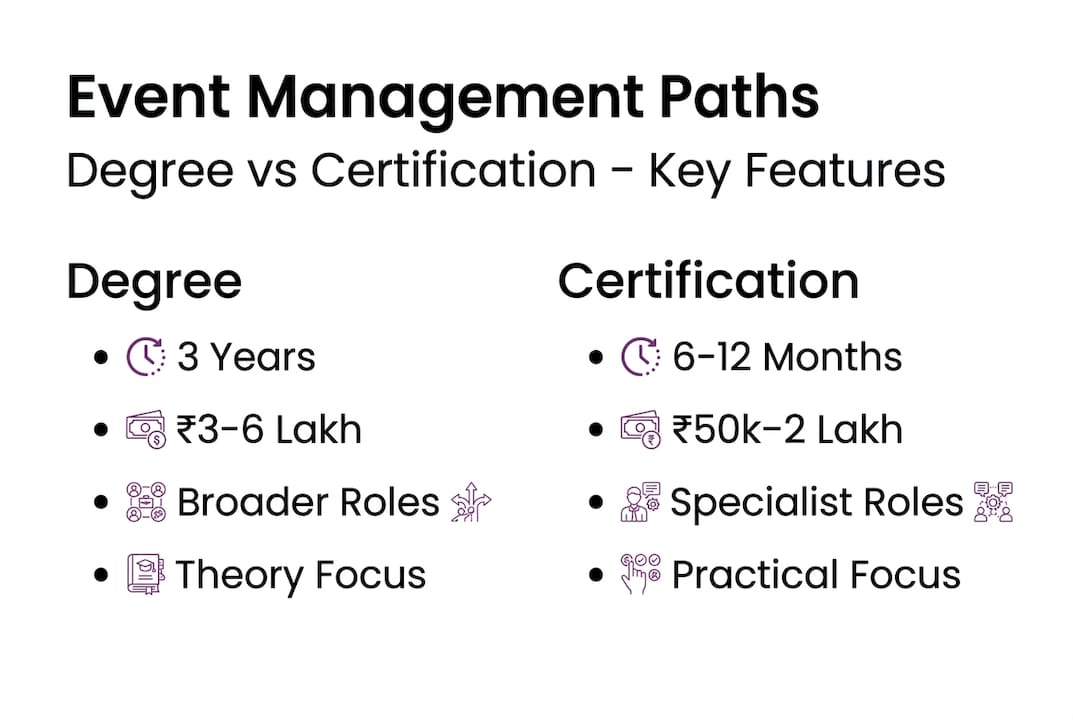
Understanding the fundamental differences between degrees and certifications helps you evaluate which path suits your career timeline and financial situation. Event management degrees typically span three years and provide comprehensive business education covering budgeting, risk management, strategic planning, and organisational behaviour. These programmes cost between ₹3-6 lakh but prepare graduates for managerial positions with starting salaries of ₹3-5 lakh annually.
Certifications and diplomas, by contrast, condense practical skills into 6-12 month programmes costing ₹50,000-2 lakh. These focused courses teach event coordination, vendor management, logistics, and client relations without the broader business theory. Graduates enter the workforce quickly but typically start at ₹2-3 lakh annually. For career switchers with existing work experience, certification versus diploma comparison shows that shorter programmes offer better ROI through faster employment and lower investment.
The skill sets differ significantly. Degrees incorporate marketing principles, financial analysis, human resource management, and legal frameworks alongside event-specific training. You learn to analyse market trends, develop business strategies, and manage teams at scale. Certifications prioritise hands-on competencies: creating event timelines, negotiating contracts, managing on-site operations, and troubleshooting last-minute challenges. This practical focus makes certified professionals immediately productive in coordinator or assistant roles.
Key differences at a glance:
- Duration: Degrees require 3 years; certifications take 6-12 months
- Investment: Degrees cost ₹3-6L; certifications ₹50k-2L
- Starting salary: Degree holders earn ₹3-5L; certification holders ₹2-3L
- Skills focus: Degrees emphasise business management; certifications prioritise practical execution
- Career entry: Certifications enable faster workforce entry; degrees require longer commitment
For those seeking event management degree job options, the broader curriculum opens pathways to event director, business development, and consultancy roles that certifications alone rarely access. However, certifications excel at launching careers quickly, particularly valuable when you need immediate income or want to test the industry before committing to a full degree.

Pro tip: Pursue a certification first to gain practical experience and industry contacts, then complete a degree part-time whilst working. This approach builds your CV whilst minimising financial risk and career gaps.
How career switchers and aspiring managers benefit from event management education
Your career stage and goals determine which educational path delivers the best return. Career switchers already possess transferable skills from previous roles but need industry-specific knowledge and credentials to break into event management. For this group, certifications and diplomas boost employability by 35-40%, especially when combined with internships that provide practical exposure and networking opportunities.
Short diplomas and certifications suit switchers because they minimise career disruption. You can complete programmes whilst working your current job, particularly with hybrid or online formats. The ₹50,000-2 lakh investment pays back quickly once you secure your first event role. Many switchers leverage existing project management, communication, or client service experience to fast-track into coordinator positions after just six months of focused training.
Aspiring managers entering the workforce fresh benefit differently. Without prior work experience, a degree provides crucial business foundations and signals commitment to employers. The three-year timeline allows for multiple internships, building a portfolio of real events before graduation. Degrees also facilitate campus recruitment, with many institutes maintaining placement partnerships that certifications cannot match.
Career switcher advantages:
- Faster career transition through condensed programmes
- Lower financial investment reduces risk
- Flexible learning formats accommodate current employment
- Practical focus addresses immediate skill gaps
- Industry certifications validate career change to employers
Aspiring manager advantages:
- Comprehensive business education supports long-term growth
- Extended internship opportunities build substantial portfolios
- Campus placement services connect with hiring companies
- Peer networks form valuable professional relationships
- Degree credential required for many managerial positions
The importance of event management certification extends beyond skill acquisition. Certifications demonstrate initiative and specialisation, particularly valuable when competing against degree holders. Employers recognise that certified professionals chose targeted training over general education, often indicating stronger passion for the field.
Practical experience matters more than credentials alone. Event management internships expose you to real-world challenges, client interactions, and industry workflows that classroom learning cannot replicate. Combining any educational path with hands-on work accelerates your learning curve and makes you immediately valuable to employers. Networking tips for event students emphasise building relationships during internships, as many jobs come through industry connections rather than formal applications.
Pro tip: If budget or time constraints limit your options, start with a certification and secure internships immediately. Work in the industry for 1-2 years, then pursue a degree part-time if you want to advance into senior management roles.
Maximising career potential: combining degrees, certifications, and experience
The most successful event professionals rarely rely on a single credential. Degrees provide comprehensive business skills like budgeting and risk management essential for long-term advancement, whilst certifications develop practical, job-ready competencies for immediate employability. Combining both creates a powerful competitive advantage that neither alone can match.
Accredited programmes make the difference between wasted investment and career acceleration. UGC and AICTE recognition ensures your degree meets national education standards and gains employer recognition. Industry partnerships matter equally, as institutes connected to event companies, venues, and agencies provide internship placements and recruitment pipelines. Verify these connections before enrolling, as industry-connected event institutes consistently report higher placement rates and starting salaries.
Practical application distinguishes theoretical knowledge from professional competence. Industry values practical experience over formal education alone, with credentials accelerating prospects by 30-40% when combined with hands-on work. Seek programmes offering real event participation, not just simulated projects. Managing actual clients, budgets, and vendors teaches problem-solving skills that classrooms cannot replicate.
| Comparison factor | Event management degree | Event management certification |
|---|---|---|
| Skills learned | Business strategy, financial analysis, HR management, marketing, legal frameworks | Event coordination, vendor management, logistics, client relations, on-site operations |
| Duration | 3 years full-time | 6-12 months |
| Investment | ₹3-6 lakh | ₹50,000-2 lakh |
| Starting salary | ₹3-5 lakh annually | ₹2-3 lakh annually |
| Career trajectory | Manager, director, consultant roles | Coordinator, assistant, specialist roles |
| Best suited for | Long-term career builders, fresh graduates | Career switchers, quick entry seekers |
Five strategies to maximise career potential:
- Choose accredited programmes: Verify UGC/AICTE recognition for degrees and industry certifications from recognised bodies to ensure employer acceptance and education quality.
- Secure multiple internships: Aim for 2-3 internships across different event types (corporate, social, sports) to build diverse experience and discover your specialisation.
- Network strategically: Attend industry events, join professional associations, and maintain relationships with instructors, alumni, and internship supervisors who become valuable references and job sources.
- Pursue continuous certification: Add specialised certifications in wedding planning, sports events, or digital event technology as your career progresses to maintain competitive edge.
- Apply learning practically: Volunteer for local events, start small freelance projects, or assist established planners to practise skills between formal education and employment.
Understanding event management course eligibility helps you plan your education timeline. Most degrees require 10+2 completion, whilst certifications often accept working professionals without specific academic prerequisites. This flexibility allows you to start learning immediately regardless of educational background.
The combined approach works because degrees and certifications address different employer needs. Degrees prove you can think strategically, manage complexity, and lead teams over extended projects. Certifications demonstrate you can execute tasks efficiently, solve immediate problems, and contribute from day one. Together, they position you as both a doer and a thinker, valuable at any career stage.
Choosing the right event management education path for you
Selecting your education path requires honest assessment of your goals, constraints, and timeline. Start by defining your target role. If you aspire to event director or business owner positions, a degree provides essential business knowledge and credibility. For coordinator or specialist roles, certifications deliver faster results with lower investment. Career switchers benefit most from flexible hybrid and online certifications that allow working whilst learning, avoiding income loss during transition.
Accreditation deserves primary consideration. Unaccredited programmes risk wasted time and money, as employers may not recognise your credentials. Verify UGC or AICTE approval for degrees and check industry recognition for certifications. Speak with alumni about their employment outcomes and employer feedback regarding the programme’s reputation. This due diligence prevents costly mistakes.
Essential evaluation criteria:
- Accreditation status and regulatory approval
- Course content alignment with your career goals
- Total fees including materials and examination costs
- Programme duration and schedule flexibility
- Internship availability and industry partnerships
- Delivery mode (on-campus, online, hybrid) matching your situation
- Placement support and alumni network strength
- Faculty credentials and industry experience
Budget constraints affect everyone differently. If ₹3-6 lakh for a degree strains your finances, starting with a ₹50,000-2 lakh certification makes practical sense. You can earn whilst learning and save for a degree later if needed. Many successful event professionals built careers entirely on certifications and experience, pursuing degrees only when seeking senior management roles requiring formal credentials.
Mode of delivery matters more than many realise. Online event management courses suit working professionals and those outside major cities, but ensure they include practical components through local internships or hybrid sessions. Fully online programmes without hands-on elements may leave you unprepared for the physical demands of event execution.
Step-by-step evaluation process:
- Define your career goal: Identify your target role, industry sector, and 3-5 year career vision to match education requirements.
- Assess your constraints: Calculate available budget, time commitment, and whether you can study full-time or need flexible scheduling.
- Research accredited options: List UGC/AICTE approved degrees and recognised certifications meeting your criteria using resources like best event management courses.
- Compare practical components: Evaluate internship opportunities, industry partnerships, and hands-on learning elements across programmes.
- Verify outcomes: Contact alumni, check placement statistics, and research employer opinions about each programme’s graduates.
- Calculate total ROI: Consider fees, opportunity cost, expected salary increase, and time to recoup investment for each option.
Your current experience level influences the decision. Fresh graduates benefit from degree structure and campus recruitment. Professionals with 2-5 years in related fields can leverage certifications to pivot quickly. Those with 5+ years might pursue executive programmes or specialised certifications that recognise existing expertise whilst adding event-specific skills.
Pro tip: Before committing to any programme, attend free webinars, request curriculum details, and speak with at least three alumni about their post-graduation experiences. This research reveals whether promises match reality and helps avoid programmes with poor industry reputation.
Explore event management courses and certifications with team i
team i offers accredited event management education tailored to diverse career goals and schedules. Whether you seek a comprehensive degree programme or focused certification, our 23 years of industry experience ensures relevant, practical training. Our event management course details outline curriculum, duration, and specialisation options across corporate, social, sports, and wedding events.
Career switchers benefit from our online event management courses that accommodate working schedules whilst providing hands-on project experience. Our hybrid format combines digital learning with practical workshops and internships through our DNA Entertainment Networks partnership, ensuring you gain real-world exposure alongside theoretical knowledge.
Understanding the importance of certification in event management helps you recognise how targeted credentials boost employability by 35-40%. Our certification programmes focus on immediately applicable skills, preparing you for coordinator roles within months. Combined with our placement support and industry connections across Bangalore and India, you receive education that translates directly into career opportunities.
Is an event management degree worth it?
What salary can I expect with an event management degree versus certification?
Degree holders typically start at ₹3-5 lakh annually, whilst certification holders begin at ₹2-3 lakh. However, your practical experience and internships significantly impact starting offers. Combining certifications with strong portfolios can sometimes match degree holder salaries, particularly in smaller agencies valuing skills over credentials.
Should career switchers pursue degrees or certifications first?
Career switchers gain better ROI from certifications initially. The 6-12 month timeline and ₹50,000-2 lakh investment allow faster career transition with less financial risk. You can pursue a degree later if seeking senior management roles, but certification versus diploma event careers shows certifications provide sufficient foundation for most coordinator and specialist positions.
Do employers prefer degrees or practical experience in event management?
Employers value practical experience most, but credentials accelerate your prospects by 30-40%. Degrees open doors to larger organisations and corporate event departments requiring formal education. Smaller agencies and boutique firms often prioritise portfolios and references over degrees. The ideal combination includes both formal education and substantial hands-on work.
What are the eligibility requirements for event management courses in India?
Most degree programmes require 10+2 completion from a recognised board. Certifications typically accept working professionals without specific academic prerequisites, though some advanced certifications may require relevant work experience. Check event management course eligibility for detailed requirements across different programme types and institutions.
Can I complete an event management degree whilst working?
Some institutions offer part-time or weekend degree programmes, though these extend the typical three-year duration to 4-5 years. Online and hybrid formats provide more flexibility for working professionals. However, degrees require significant time commitment for projects, internships, and examinations. Certifications better accommodate full-time employment through condensed, focused curricula and flexible scheduling options.