

Choosing between an event management diploma and degree in India can feel overwhelming. Many students and young professionals wonder which path truly aligns with their career goals, budget, and timeline. The Indian event industry is expanding rapidly, creating abundant opportunities for qualified professionals. However, the certification you choose significantly impacts your career trajectory, salary potential, and long-term growth. This guide clarifies the differences, benefits, and outcomes for diploma versus degree holders, helping you make an informed decision that matches your aspirations.
Table of Contents
- Key takeaways
- Understanding diploma and degree programmes in event management
- Career prospects and salary comparisons for diploma vs degree holders
- How industry growth shapes education choice in India’s event sector
- Choosing the best path: factors to consider between diploma and degree
- Explore our event management courses and take the next step
- Frequently asked questions
Key Takeaways
| Point | Details |
|---|---|
| Faster entry with diplomas | Diplomas offer faster entry into the industry and are more cost effective. |
| Longer term growth with degree | Degrees provide broader career growth and access to a wider range of roles. |
| Degree earns thirty percent more | Degree holders typically start with around thirty percent higher salaries than diploma holders. |
| Accreditation shapes placements and salaries | Accreditation by recognised bodies influences employer perceptions, placement prospects and starting salaries. |
Understanding diploma and degree programmes in event management
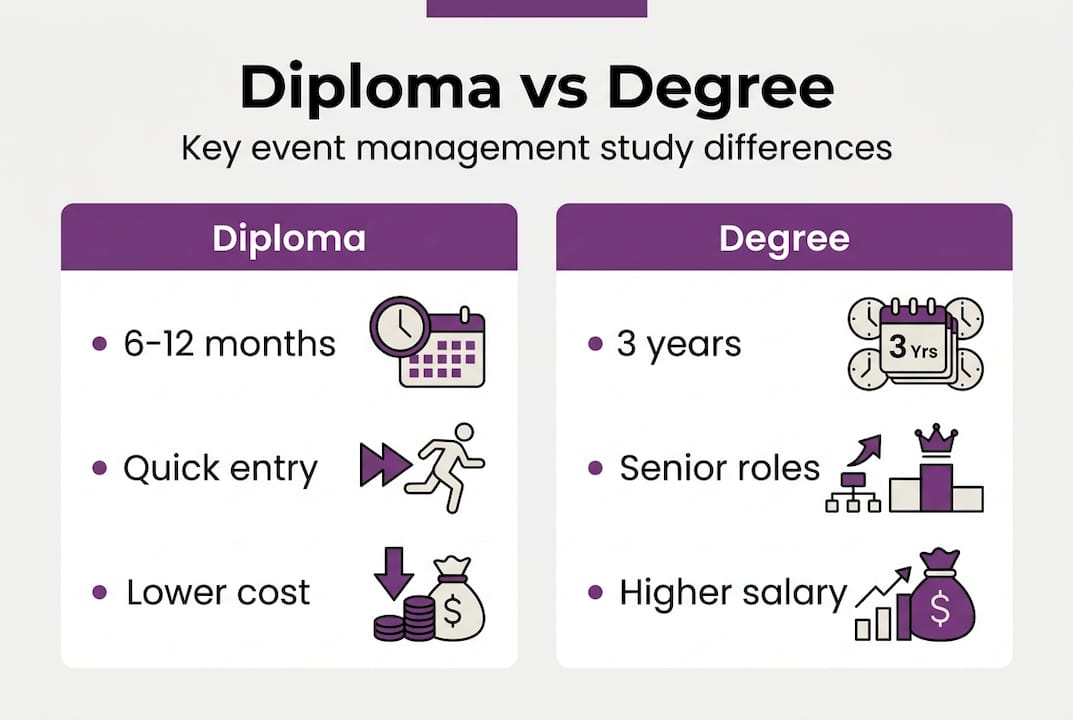
Event management diplomas and degrees serve different purposes in your career journey. Diplomas typically run six months to one year, focusing intensively on practical skills like vendor coordination, budgeting, and on-ground event execution. These programmes prioritise hands-on training, preparing you for immediate workforce entry. Degrees span three to four years, combining theoretical foundations with management principles, leadership development, and strategic planning. You’ll study marketing, finance, human resources, and project management alongside event-specific modules.
Accreditation by UGC or AICTE critically influences how employers perceive your qualification. Recognised accreditation signals quality education and industry-relevant curriculum, directly affecting placement opportunities and starting salaries. Diplomas suit students seeking flexible schedules, career switchers, or those needing quick entry into the workforce. Degrees appeal to individuals aiming for corporate roles, leadership positions, or international opportunities.
Key differences include:
- Diplomas emphasise immediate job readiness through intensive practical training
- Degrees develop comprehensive business acumen alongside event expertise
- Diploma holders often start in assistant or coordinator roles
- Degree graduates access management trainee and specialist positions
- Accredited programmes from both categories outperform unaccredited alternatives
The certification versus diploma debate extends beyond duration. Consider your learning style, career timeline, and professional ambitions. Diplomas excel at building specific competencies quickly, whilst degrees cultivate broader strategic thinking and organisational understanding. Both pathways can lead to successful careers, but your choice shapes the trajectory and pace of your professional development.
Pro Tip: Research alumni outcomes and placement records before selecting any programme. Speak with graduates to understand real-world career progression and employer perceptions of different qualifications.
Career prospects and salary comparisons for diploma vs degree holders
Diploma holders typically enter the industry as event coordinators, assistant planners, or specialised roles in wedding and social event companies. Starting salaries range from ₹2 to 3 lakhs annually, with growth dependent on experience and portfolio development. These positions focus on execution, vendor management, and client coordination. You’ll gain practical experience quickly, building a reputation through successful events.

Degree holders access higher-paying corporate event roles, brand activation positions, and large-scale event management opportunities. Entry-level salaries span ₹3 to 5 lakhs per annum, representing approximately 30 percent higher earnings than diploma counterparts. Corporate clients and international event firms prefer degree qualifications for management trainee programmes and specialist roles. Your theoretical knowledge and business understanding enable you to contribute to strategy, budgeting, and stakeholder management from day one.
Experience dramatically impacts earning potential for both pathways. Diploma holders with five years of experience can reach ₹5 to 7 lakhs annually, particularly when specialising in high-demand niches like destination weddings or celebrity events. Experienced degree holders achieve ₹8 to 15 lakhs annually, often progressing to senior management, client servicing heads, or entrepreneurial ventures. The gap widens at senior levels, where strategic thinking and leadership capabilities become paramount.
| Experience Level | Diploma Holder Salary | Degree Holder Salary |
|---|---|---|
| Entry (0-2 years) | ₹2-3 lakhs | ₹3-5 lakhs |
| Mid (3-5 years) | ₹4-6 lakhs | ₹6-9 lakhs |
| Senior (5+ years) | ₹6-8 lakhs | ₹8-15 lakhs |
Career trajectories differ significantly:
- Diploma holders often specialise in specific event types, building niche expertise
- Degree holders more frequently move into management, business development, or consultancy
- Corporate advancement opportunities favour degree qualifications
- Entrepreneurial success depends more on skills and network than qualification type
Job security and growth potential correlate with education level in formal organisations. Multinational companies and established agencies typically require degrees for management track positions. However, the event industry also rewards talent, creativity, and proven success regardless of qualification. Your diploma in event management can open doors to freelance work and entrepreneurship, whilst degree qualifications support structured corporate careers.
Pro Tip: Supplement any qualification with strong portfolio work, industry networking, and continuous skill development. Employers value demonstrated success and adaptability alongside formal credentials.
How industry growth shapes education choice in India’s event sector
India’s event industry demonstrates remarkable expansion, growing at 20 to 25 percent annually with projections reaching $5 to 9 billion by 2028 to 2031. This growth creates substantial opportunities across corporate events, weddings, entertainment, sports, and exhibitions. The sector’s diversification means both diploma and degree holders find relevant roles, but the nature of opportunities differs significantly.
Degrees unlock access to formal corporate and international event markets, where clients expect strategic planning, risk management, and comprehensive project oversight. Multinational corporations, government agencies, and large-scale event producers prioritise degree qualifications when hiring for management positions. These roles involve stakeholder coordination, budget accountability, and long-term planning that benefit from theoretical foundations.
Diplomas fit fast-entry roles in weddings, social celebrations, and entertainment events where practical execution skills matter most. India’s thriving wedding industry alone generates massive demand for coordinators who understand vendor management, cultural sensitivities, and on-ground logistics. You can establish yourself quickly, building a client base and reputation through successful event delivery.
Market dynamics favour qualified professionals:
- Skill gaps exist across all event sectors, creating opportunities for trained talent
- Clients increasingly demand professional certification and proven expertise
- Competition intensifies as more people enter the industry
- Specialisation in niches like sustainable events or virtual experiences adds value
- Higher education correlates with better services sector jobs
Accreditation and real-world experience distinguish candidates in this growing market. Employers receive numerous applications for each position, making recognised qualifications and practical internships essential differentiators. Your education choice should align with target sectors and long-term goals. Corporate event aspirations benefit from degree pathways, whilst entrepreneurial or freelance ambitions may thrive with diploma foundations supplemented by portfolio development.
“The Indian event industry’s rapid expansion creates unprecedented opportunities, but success requires matching your qualification to your intended career path and target market.”
Investment in education yields returns when aligned with market demand. Research which event sectors interest you most, then select qualifications that employers in those sectors value. The international event management scope continues expanding, particularly for degree holders with language skills and cultural awareness.
Pro Tip: Attend industry events and speak with working professionals about hiring trends in your target sector. Their insights reveal which qualifications employers currently prioritise and emerging skill requirements.
Choosing the best path: factors to consider between diploma and degree
Your decision between diploma and degree should reflect personal circumstances, career ambitions, and practical constraints. Consider these critical factors systematically:
- Assess your budget and financial capacity for education investment
- Evaluate your timeline for entering the workforce
- Clarify your career focus: execution roles versus strategic management
- Research target employers and their qualification preferences
- Consider long-term goals including international opportunities or entrepreneurship
Diplomas benefit individuals seeking immediate entry, career switchers from other fields, or those with budget constraints. The shorter duration means faster return on investment through employment. You’ll develop practical competencies quickly, positioning yourself for entry-level roles within months. This pathway suits people who learn best through hands-on experience and prefer applied knowledge over theoretical frameworks.
Degrees serve those aiming for senior roles, international exposure, and higher long-term earnings. The extended study period allows deeper exploration of business principles, leadership development, and strategic thinking. You’ll build a comprehensive skill set that supports career progression into management and consultancy. Degrees offer leadership and global opportunities that diplomas may not directly access.
| Decision Factor | Choose Diploma If | Choose Degree If |
|---|---|---|
| Timeline | Need quick entry (6-12 months) | Can invest 3-4 years |
| Budget | Limited funds available | Can afford higher investment |
| Career goal | Execution and coordination | Management and leadership |
| Work style | Hands-on, practical focus | Strategic, analytical approach |
| Sector target | Weddings, social, entertainment | Corporate, international, large-scale |
Practical considerations matter significantly:
- Diploma programmes often offer evening or weekend schedules for working professionals
- Degrees typically require full-time commitment, though some institutions offer flexible options
- Both pathways benefit enormously from internships and real event exposure
- Portfolio development matters regardless of qualification type
- Industry networking accelerates career growth for diploma and degree holders alike
Internships complement both pathways and enhance employability substantially. Practical experience demonstrates your capabilities to employers, often mattering as much as formal qualifications. Seek programmes that integrate internships, live projects, or industry partnerships. Verify course eligibility requirements before applying, as some degree programmes require specific academic backgrounds.
Accreditation verification protects your investment and career prospects. Confirm that programmes hold recognition from UGC, AICTE, or relevant industry bodies. Unaccredited courses may cost less initially but limit employment opportunities and salary potential significantly. Research alumni outcomes, placement records, and employer partnerships when evaluating programmes.
Events management work experience gained during or immediately after your studies proves invaluable. Many successful event professionals combine diploma qualifications with extensive practical experience, matching or exceeding the career progression of degree holders. Your dedication, creativity, and professional network ultimately determine success more than qualification type alone.
Pro Tip: Consider hybrid approaches like completing a diploma first, gaining work experience, then pursuing a degree part-time if career goals evolve. This strategy balances immediate income needs with long-term advancement potential.
Explore our event management courses and take the next step
team i offers comprehensive diploma and degree courses in event management, designed to match diverse career goals and learning preferences. Our programmes combine accreditation-backed education with practical internships, providing strong foundations for industry success. With 23 years of experience and partnerships with DNA Entertainment Networks, we deliver industry-relevant training that employers value.
Flexible online event management courses help you balance education with existing commitments, whilst in-person options provide immersive learning experiences. Our curriculum covers social events, sports management, wedding planning, and corporate events, allowing you to specialise according to your interests. Students gain hands-on experience through live projects and real event participation.
Discover everything you need to know about our event management course offerings, including specialisation options, placement support, and alumni success stories. Our events management work experience programmes connect you with industry professionals and potential employers, accelerating your career launch. Whether you choose a diploma or degree pathway, team i provides the education, experience, and industry connections to help you succeed.
Frequently asked questions
What is better for quick entry: diploma or degree?
Diplomas typically offer faster completion and entry into the workforce compared to degrees, with programmes running six months to one year. This pathway suits students seeking prompt employment or career switches. You’ll develop practical skills quickly and start earning sooner, though long-term career progression may require additional qualifications or extensive experience.
How much more can degree holders earn compared to diploma holders initially?
Degree holders typically earn ₹3 to 5 lakhs per annum at entry level, whilst diploma holders earn ₹2 to 3 lakhs, representing roughly 30 percent higher starting salaries. This salary advantage grows with experience as degree holders access senior roles reaching ₹8 to 15 lakhs annually. The gap reflects broader responsibilities and strategic contributions expected from degree-qualified professionals.
Does industry accreditation affect job placement?
Accreditation by bodies like UGC and AICTE significantly improves placement chances and salary offers. Accredited programmes signal quality education and industry-relevant curriculum to employers. Unaccredited courses may limit opportunities, especially in formal corporate sectors where human resources departments filter candidates by recognised qualifications. Always verify accreditation status before enrolling.
Can I switch from a diploma to a degree later on?
Many institutions allow diploma holders to pursue degree programmes later, sometimes offering credit transfers or accelerated pathways. This strategy enables you to start earning quickly through diploma-based employment whilst keeping long-term advancement options open. The combination of practical experience and subsequent degree qualification can enhance skills and career growth potential significantly, positioning you competitively for senior roles.